3D Bubble Match: Bubble Pop
- 4.9
- Rating
- 1.00M
- Installs
- Free
- Price
 Analysis by App-foxy
I keep coming back to 3D Bubble Match: Bubble Pop for one simple reason: it understands the value of a game that can start immediately and ask very little from me. It is a free puzzle game from Gloryway Puzzle, built around arranging and matching colorful three-dimensional bubbles. The idea is easy to grasp within moments, but the visual presentation gives the familiar bubble-shooter formula a slightly different feel.
My first impression was that this is best approached as a short-session game rather than a title demanding a long, uninterrupted commitment. I can open it when I have a few spare minutes, make progress, and put it down without feeling as though I have abandoned a complicated story or lost track of a large set of objectives. That simplicity is its biggest strength, although it also explains why players looking for deep strategy or constant novelty may eventually want something more substantial.
Why the first few minutes work so well
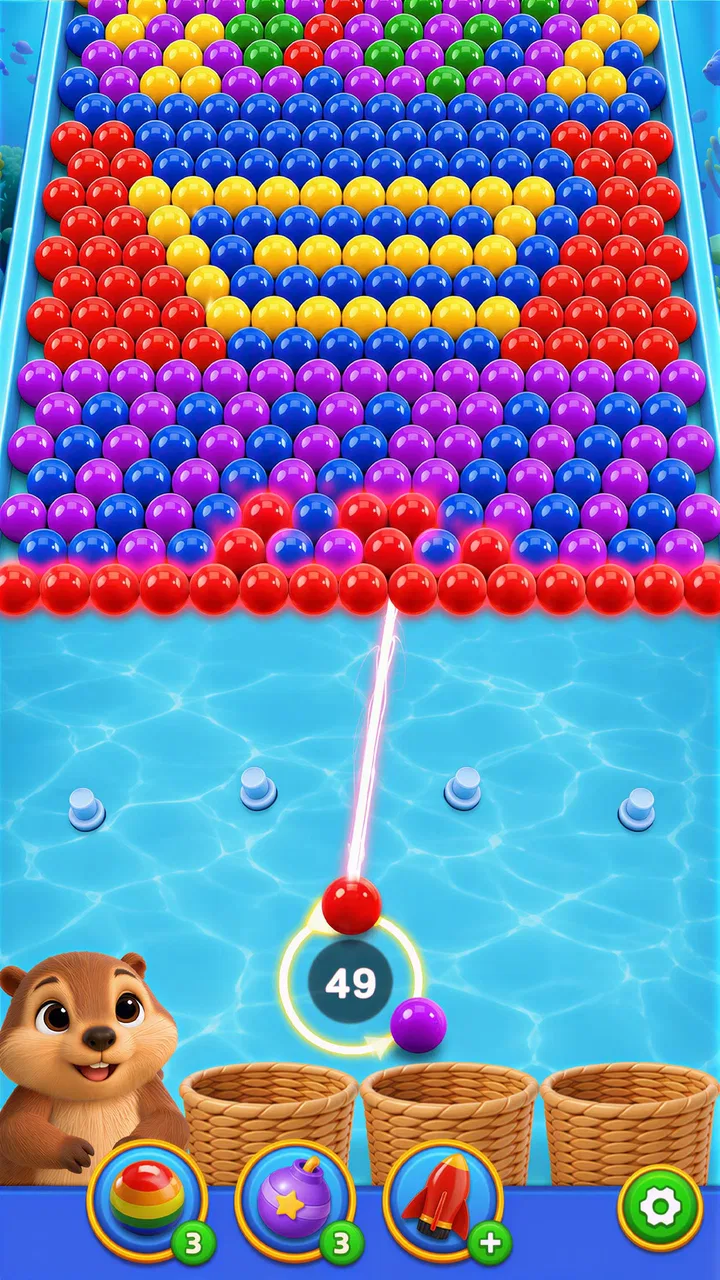
The central appeal is immediate visual feedback. Matching bubbles produces the kind of quick response I expect from a casual puzzle game: I look for a useful group, make a move, and see the board react. The three-dimensional presentation makes the objects feel more tactile than flat colored circles, even though the underlying pleasure still comes from recognizing patterns and choosing a sensible shot.
You May Also Like

 Blood Strike: 2.5 Anniversary
Blood Strike’s Loadouts Turn Every Drop Into a Tactical Gamble
A close look at Blood Strike’s custom loadouts: how fast access to signature weapons reshapes its battle royale rhythm, rewards preparation, and narrows the gap between fights.

 Pandora - Music & Podcasts
Pandora’s Music Is Easy to Start, but Harder to Recover
Pandora’s strength is its low-effort path from a seed to a station. Its weak spot is how much confidence it asks you to place in connection, setup, and quiet recovery.

 8 Ball Pool
 Is Built on Rivalries, Rematches, and Routine
A close look at the rivalries, rematches, shared routines, and unanswered safety questions that turn a quick pool match into a persistent mobile community.

 Samsung Music
’s Quiet Strength Is Playing What You Already Own
Its reach comes less from spectacle than from dependable access to a personal library. That simplicity is both the app’s strongest retention engine and its ceiling.

 AccuWeather: Weather Radar
AccuWeather Review: A Quick, Clear Forecast for Everyday Decisions
For everyday plans, the best forecast is the one you can understand quickly. AccuWeather makes rain timing, radar, and local conditions easy to act on, with a few trade-offs.

 Hill Climb Racing
Why Hill Climb Racing Still Turns Crashes Into One More Run
A tiny car, a bumpy hill and one more upgrade: Hill Climb Racing keeps resurfacing because its simple chaos makes every near-miss feel personal.
More From Our News Desk



I appreciate that the game does not require a long explanation before I can begin. That matters when I am playing during a coffee break or waiting for an appointment. I do not need to remember a complicated control scheme, learn a large inventory, or understand a story before the first meaningful action. The short description calls it “3D Bubble Match,” and that is a fair way to understand the experience: it takes a familiar matching concept and puts it into a more visual, spatial-looking package.
The artistic presentation is also part of the hook. The bubbles are not merely functional pieces on a plain board; their rounded appearance and color separation make the playfield pleasant to scan. That helps the game feel lighter than a dense logic puzzle. At the same time, players who have difficulty distinguishing similar colors should be cautious, because color recognition is naturally important in this kind of design.
What I like most is the low barrier between opening the game and making a decision. Many mobile puzzles lose momentum by surrounding the board with too much setup. Here, the attraction is the board itself. I can focus on the next match instead of managing several layers of menus or systems. For a casual player, that is a meaningful advantage.
The game is listed for Everyone, which fits the accessible presentation and uncomplicated premise. I would still describe it as more suitable for people who enjoy visual matching than for anyone seeking a narrative adventure, competitive action, or a demanding brain-training program. Its friendliness is genuine, but it comes from simplicity rather than from a wide range of play styles.
A rhythm built for spare minutes
In everyday use, I find the strongest fit is the in-between moment: a short wait before an appointment, a quiet break at work, or a few minutes on the sofa before doing something else. The game gives me a clear activity without requiring me to reserve an entire evening. I can make a handful of moves, enjoy the small satisfaction of a successful match, and stop when my attention shifts.
That rhythm also makes it approachable for family members who do not usually play games. Someone can understand the basic goal by watching a single round, then try it without needing a tutorial session. It is less intimidating than a puzzle game with a large rulebook, and less demanding than a fast arcade game that punishes every moment of hesitation.
There is a useful trade-off here. The same clarity that makes the game comfortable during a brief break can make it feel modest for longer sessions. I do not open it expecting a dramatic change of pace every few minutes. Its pleasure comes from repeating a small loop: inspect the bubbles, decide on a match, watch the result, and prepare for the next choice. If that loop is satisfying to you, the game feels relaxing. If you need constant surprises, it may start to blur together.
My practical advice is to treat each visit as a compact puzzle session instead of trying to force a long play period. That approach makes the game’s strengths more visible. When I play beyond the point where the matching action still feels fresh, the simplicity becomes more noticeable. The title is at its best when it fills a small gap in the day, not when it is expected to carry hours of focused entertainment.
How interruption-friendly is it?
This is where the game’s casual identity matters most. A puzzle based on individual visual decisions is naturally easier to leave than a game built around real-time combat or a multiplayer match. If I need to put my phone down suddenly, I am not walking away from a team, missing a dialogue choice, or failing an action sequence that depends on constant attention.
That makes it a sensible choice for fragmented routines. I can play while waiting for food, between household tasks, or during a short commute when it is safe and appropriate to use a phone. The important point is not that every session is identical, but that the game’s basic structure does not demand the same uninterrupted concentration as a more elaborate puzzle or action title.
I would not confuse interruption tolerance with unlimited convenience. Any puzzle can become frustrating if I leave it at the wrong moment or return without remembering the board’s pattern. The best habit is to finish a small decision point before switching away rather than abandoning the game halfway through a move. That keeps the return experience clean and prevents the feeling that I have to reconstruct what I was planning.
When I return after a break, the visual nature of the board helps me reorient quickly. I can usually look at the current arrangement and understand what deserves attention. This is one of the less obvious benefits of the design: it does not rely heavily on remembering a long chain of instructions. The board itself tells me where to look next.
That quality makes it more practical than many story-heavy mobile games for people who play in short fragments. It also makes it a poor substitute for a deeper strategy title if you want a session to build toward a carefully planned long-term solution. The game is forgiving in the sense that it is easy to resume, but it is not trying to create an elaborate memory challenge.
Where the matching loop stays enjoyable
The immediate pleasure comes from making a correct visual judgment and seeing the result unfold. I enjoy the small pause before committing to a move, especially when there is more than one possible match and I have to decide which arrangement is likely to be more useful. Even a simple board can create a moment of thought when I resist the first obvious option and look for a better sequence.
That is also the point where I would encourage new players not to rush every move. The most satisfying play is not simply tapping the first group that catches the eye. I get more from scanning the whole visible area, identifying matches that may open space, and choosing the move that leaves the board easier to read. This habit turns the experience from pure reflex into a light planning exercise without making it feel heavy.
A second useful tip is to pay attention to board clarity rather than chasing the most colorful or visually prominent group. The largest-looking match is not automatically the best choice. Sometimes the better move is the one that reduces clutter or creates a cleaner set of options afterward. That is a small distinction, but it gives the game more thoughtfulness than the store summary alone suggests.
I also find that the 3D styling changes how I inspect the board. With flat bubble games, I tend to read the layout almost like a grid. Here, the rounded objects encourage me to look at clusters as shapes rather than only as positions. The difference is subtle, but it helps the presentation feel like more than a simple reskin.
Still, the underlying loop remains familiar. Players who have spent a lot of time with conventional bubble shooters will recognize the basic satisfaction quickly. The 3D treatment adds visual character, but it does not completely reinvent the category. That is important when deciding whether to install it: this is a polished casual variation on a known idea, not a replacement for every other puzzle format.
Replay value and the limits of repetition
Replay value here depends heavily on how much you enjoy repeating a focused action. I can return to the game because matching bubbles is easy to understand and pleasant to perform, especially when I want something low-pressure. The lack of a complicated entry routine helps; I do not need to rebuild momentum before I can enjoy the next board.
However, I would not recommend it to someone whose main requirement is a constant stream of new mechanics. The basic appeal comes from the same visual search and matching decisions each time. That consistency is excellent for relaxation and poor for players who measure replay value by surprise, story development, or dramatic variation.
Compared with a traditional flat bubble shooter, this game’s main distinction is presentation. The three-dimensional bubbles make the board more attractive and give familiar actions a slightly different visual identity. Compared with a match-three puzzle, it feels more focused because the bubble theme and shooting-style logic keep attention on clusters rather than on a broad grid of interchangeable pieces.
A match-three alternative may be better for someone who wants cascading combinations, power-up chains, or a more obviously strategic grid. A competitive bubble shooter may be a better fit for players who want pressure from a countdown or another player. I prefer this game when I want the middle ground: more interaction than passively scrolling, but less intensity than a timed or competitive challenge.
There is another trade-off involving spending. The game is free to download, while in-app purchases range from $1.99 to $64.99 per item. I would approach those purchases deliberately rather than treating them as part of the basic requirement for enjoying the game. For a casual player, the sensible test is whether the free experience already provides enough short sessions before considering any optional spending. Anyone uncomfortable with purchase prompts should review their device’s safeguards before handing the game to a child.
The current version is 2.2901, and the game requires Android 6.0 or later. That makes it relevant to people using older Android phones that cannot run many newer games, provided the device meets that minimum. The developer, Gloryway Puzzle, has positioned the title toward a broad casual audience, and the technical entry point supports that accessible role.
Who should play it, and who should skip it?
I would recommend it to someone who wants a colorful puzzle for short, repeatable visits. It suits players who like matching games but do not want to learn a complex system, and it works particularly well for people who value quick re-entry after interruptions. It is also a reasonable choice for a family device because the premise is easy to explain and the age rating is Everyone.
It is less suitable for players who need a strong narrative, a competitive ladder, or a large strategic toolbox. If you usually judge a puzzle game by how many distinct mechanics it offers, this one may feel too narrow. Likewise, if you prefer calm games with no possibility of purchase pressure, the in-app purchase range is worth considering before installing.
Another group that may want to skip it is anyone who becomes bored by repetition quickly. The visual polish can make the first sessions inviting, but presentation alone cannot turn a familiar matching loop into an endlessly changing experience. I would choose a more feature-heavy match-three game when I want long-term progression, and a faster arcade shooter when I want urgency rather than relaxation.
For everyone else, the decision is fairly straightforward: install it if the thought of arranging 3D bubbles during small breaks sounds appealing. Do not install it expecting a deep puzzle laboratory. Its value is narrower and more practical. It gives me a clean, attractive activity that I can pick up quickly, pause without much disruption, and revisit whenever I want a few uncomplicated decisions.
My casual verdict
After spending time with it, I see 3D Bubble Match: Bubble Pop as a dependable short-session puzzle rather than an ambitious all-purpose game. Its strongest qualities are the instant hook, the readable matching loop, and the way naturally it fits around interruptions. I can enjoy it without preparing for a long session, and I do not feel punished when daily life pulls my attention elsewhere.
The 4.9 average from around 30 thousand ratings and more than a million installs suggest that this simple formula has found a broad audience. Those figures do not change my personal judgment, but they fit the experience: this is the kind of game many people can understand immediately and enjoy in small doses.
My final recommendation is positive with a clear condition: choose it for accessible bubble matching, attractive 3D presentation, and easy pick-up-and-play sessions. Skip it if you need major mechanical variety, deep strategy, or a competitive reason to keep returning. For my own casual gaming routine, it earns a place when I want immediate pleasure without a long commitment, and that is exactly where it performs best.
FAQs for 3D Bubble Match: Bubble Pop
01What is 3D Bubble Match: Bubble Pop, and how is the gameplay structured?
3D Bubble Match: Bubble Pop is a casual puzzle game centered on finding and matching identical three-dimensional bubbles or objects. Instead of simply aiming and shooting, you generally rotate or inspect a colorful 3D arrangement, select matching items, and clear them from the board. The early levels are easy to understand, while later stages introduce more crowded layouts, limited space, obstacles, and time or move pressure that require faster observation and better planning.
02Is 3D Bubble Match: Bubble Pop free to download and play?
The game can generally be downloaded and played without an upfront purchase, making it accessible for casual players who want a quick puzzle experience. However, free-to-play games commonly include optional advertisements, bonus offers, or in-app purchases for extra tools, lives, boosters, or other conveniences. Before downloading, check the current store listing for pricing details, available purchases, and whether advertising or optional payment features are included in your region.
03Does the game require an internet connection to play?
Many levels in 3D Bubble Match: Bubble Pop may be playable without a continuous internet connection, which is useful when traveling or when mobile data is limited. Nevertheless, an internet connection can be required for advertisements, rewards, cloud-related features, updates, event content, or purchase verification. Offline behavior may also vary between versions and devices, so it is best to test the game after installation rather than assuming every feature works without connectivity.
04Is 3D Bubble Match: Bubble Pop suitable for children and all age groups?
The game uses simple matching mechanics, bright visuals, and non-violent puzzle gameplay, so it can be appealing to children, teenagers, and adults. Younger players may still encounter advertisements, optional purchases, or difficulty that encourages repeated attempts. Parents should review the app-store age rating, privacy information, and device purchase settings before allowing children to play. If the game displays third-party ads, supervision may also be appropriate.
05What should I know about advertisements, in-app purchases, and game progress?
Players should expect that the free version may use advertisements to support development, with some ads appearing between levels or being offered in exchange for rewards. Optional purchases may provide boosters, extra attempts, or an ad-free experience, but they are not necessarily required to begin playing. Progress and rewards can depend on the installed version, device storage, and account features, so avoid deleting the app before confirming whether your progress is backed up.
Pros
- Simple tap-to-match controls are easy for players of all ages.
- Short levels make it suitable for quick gaming sessions.
- Bright 3D visuals give the bubbles a polished
- playful appearance.
- Gradually increasing difficulty keeps the gameplay engaging.
- Offline play is convenient when you have no internet connection.
Cons
- Repeated matching mechanics may become monotonous over time.
- Some levels can feel more dependent on luck than strategy.
- The 3D presentation may use more battery on older devices.
- Progression can feel slow without spending extra time playing.
- Ads may interrupt the experience between levels.

3D Bubble Match: Bubble Pop
Gallery